When I’m shopping for my kids for birthdays or holidays, I rarely think to myself ‘is this Pagan?’ I don’t care if something is exactly my flavor of spirituality. What I’m looking for are things that foster creativity and enjoyment, and stories that reflect the values with which I and my husband are raising our family. There isn’t a lot of high quality Pagan- or Hindu-specific kid stuff out there (that I can find easily). But there are some things I’ve found and I’d like to share with you. Some of these books and media I’ve written about in other posts. I apologize for the repeats.
First, you’ll find no toys listed here. Basically anything that fosters imagination and creativity (paper and markers, blocks of any kind, dress up clothes, fake kitchen items, science kits, robotics kits, etc) are great for kids, as are anything that will get them outside. What could be more spiritual than creativity and nature? These sorts of ideas extrapolated for adults are also a good idea, because it’s rare to meet an adult who is getting enough creative or outside time. I know I’m not!
Books
We are a house full of readers. Below are some of the books I have particularly loved for kids of all ages.

Lakshmi, from Kathleen Edwards’ Holy Stars.
*Holy Stars by Kathleen Edwards is a great book for overviews of the world’s religious figures. Equal space is devoted to Jesus, the Virgin Mary, Yahweh, Muhammad, Lakshmi, Krishna, Buddha, Chango, and others. It’s all done in a graphic novel style that is engaging and fun to read. Snippets from prayers are included. It won’t tell the full story or answer all questions, but introducing kids of all ages to the world’s spiritual characters is a wonderful way to promote religious diversity, understanding, and literacy.
May not be ideal for kids under 4 or 5. Some of the gods’ stories can be…. scary. For example, the crucifixion of Jesus is not easy to explain to a 3-year-old!
Click on the image above to go to the author/illustrator’s site to see more images.
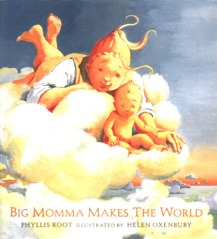 *Big Momma Makes the World, by Phyllis Root, illustrated by Helen Oxenbury, is a beautiful picture book telling the story of creation. What I love about this version is that it doesn’t use an old, white man as the Creator. Instead we see an African-American woman as the Creator. The images are simply gorgeous.The narrative voice is delightful. I think this book is appropriate for all but the most conservative of traditions.
This book is appropriate for all ages.
 * ABC Book of Shadows is a board book, perfect for tiny hands and little ones just learning their letters. I will admit that the art in this isn’t my favorite, but little eyes love the bright colors and child-like drawing. This book is written with a Wiccan point of view, and I’m not Wiccan, but you know? It doesn’t matter. As my son got older we were able to talk about some of the differences between what I believe and what the books says. No matter, this a well-loved book in our house. I’m pretty sure I have it memorized, that’s how many times we’ve read this. In fact, our copy is starting to fall apart. I don’t expect it to last beyond the third child!
Click on the image to go Itty Bitty Witch Works, the author’s small press.
 * While not explicitly Pagan or religious, but simply marvelous all the same, are the works of Swedish author/illustrator Elsa Beskow. We have three of her books and I would gladly have more! My children love the pictures as well as the stories. Beskow focuses on images and cycles of nature from her native Sweden. Characters are embodiments of the elements, seasons, or folk tradition (such as trolls) that sometimes interact with human children. Some books are slightly more Christian in theme, but none of the books are ‘religious’ in any overt way. The length of the stories might be hard for kids under 3 to sit through, but the images will grab them. Content-wise, these books are appropriate for people of all ages and all traditions.
* A great find at our local library was Gillian Cross’s wonderful retelling of The  Odyssey, with Neil Packer’s stunning illustrations. This isn’t a complete retelling, but it’s enough to entrance a child – and the parent who has to read it aloud! Books of ancient tales and myths, if well done, are popular in our house. This one was a particular favorite. In fact, we will be gifting our son with his own copy for the holidays.
Ideal to read aloud to pre-literate kids and great for older kids to read on their own. Click on the link above to see more images from inside.
 * I have written at length about The Sea of Trolls. In fact, I consider it one of the best non-magic books about magic! Here’s part of what I’ve written before:
The Sea of Trolls is set in the 8th century in Saxon ‘England’. Our hero is Jack, an 11 yr old boy. His father longs for Lindisfarne, his mother keeps bees, his 5 yr old sister Lucy insists she’s a fairy princess, and he befriends a Druidic bard. In the first few chapters of the book, Jack is the bard’s apprentice and he begins learning and witnessing magic. Then comes the Viking invasion, and he and Lucy are carried off as slaves. We briefly see Picts and then Jack and Lucy are taken across the North Sea and must venture into Jotunheim, the land of the Ice Giants/Trolls.
It’s a wonderful story, with great characters. The writing is simple – very appropriate for readers 9-11 yrs old. While I like the story and enjoy reading it aloud to my son, what blows me away is the depiction of magic and spirit.
I have read this book many times to my son. There are perhaps two chapters (one on berserking, in particular) that might be too descriptive for your under 10 child – your mileage may vary. I admit to skipping bits here and there for my son.
This book is the first in a trilogy. I enjoyed the entire trilogy, but this is by far my favorite. A great easy read for the older kid or adult who likes fantasy, myth, and/or history.
 * For teens and adults who enjoy YA writing, I recommend Robin LaFevers’ His Fair Assassins series. Grave Mercy is the first in the historical fiction series. So far there are two books; I believe the third is coming out in the spring of 2014 (I can’t wait!). What’s great about these books are the strong female protagonists. They are trained assassins and nuns for the Breton god of Death, Mortaine. The young ladies haven’t really chosen their lives, and so their motives are complicated by politics and romance. I greatly enjoyed these stories.
What makes me include them here is the complex, if fictional, depiction of ‘the old gods’ existing in a newly Christianizing world. There is also an incredibly powerful vision of the god of Death at the end of Grave Mercy that made the theologian and Pagan in me jump for joy.
 * The last book I want to recommend for kids is not spiritual at all, yet I think many readers of my blog will be interested in it. Meet Polkadot is an educational book on gender diversity for kids. Talcott Broadhead is a local (to me) author and social worker with a gender identity-diverse family. This book has bright illustrations and explores the topic through the eyes of Polkadot, a transgender child (or, for those that assume transgender means surgically altered, let me also throw in the phrase ‘gender neutral’). In a society that doesn’t know the difference between sex and gender (one is biology, the other is identity) and is suffocating under the tyranny of ‘blue is for boys, pink is for girls’ nonsense, this book is more than needed on bookshelves everywhere.
But better than my recommendation is the fact that my 5-year-old loved it. My nearly 3-year-old listened to the whole thing, though I don’t think she really understood much of it. We had great discussion afterwards, too. My son really wanted to know whether Polkadot was a boy or a girl – and that was a great opportunity to talk about the many ways people react to non-normative gender expressions.
This book is not available on Amazon. Please click on the either the picture or the link to go to Danger Dot Publishing.
Not books
* Once you’ve read all the books and you want to sit and watch something with positive Pagan values, I can recommend nothing as highly as the Avatar: The Last Airbender television series. I know, it came out years ago, but there still isn’t anything out there as compelling, with such outstanding design, strong females characters, well-written story arcs, and what I see as Pagan values. Sure, the last point is debatable, as there is nothing in the show explicitly Pagan. The series draws more from Asian and indigenous cultures than Western ones, yet this lack of Christian-based morality is a breath of fresh air. The values presented are all ones I hope my children (and myself!) emulate. I am sure I have seen every episode 30 times, and it still doesn’t bore me.
This program is suitable for kids over the age of 2 (the first season especially; the ending four episodes might be more appropriate for 5 and up – again your mileage may vary).
* Another cartoon that I recommend for its feminist leanings, excellent art and depictions of magic is My Little Pony: Friendship is Magic. I am no fan of content created for marketing, but this cartoon series was designed and spearheaded by the amazing Lauren Faust. She’s worked on the Powerpuff Girls and Foster’s Home for Imaginary Friends (two other cartoons that I am a big fan of). There is nothing spiritual about this series, but I can’t help but recommend something using magical tropes AND filled with strong female characters (and solid animation). I love Rainbow Dash, but suspect I’m more of a Twilight Sparkle. Suitable for all ages.

My son’s Ganesh murti.
* Finally, I think a small Ganesh murti can be ideal for kids. Their very own statue! Plus, small murtis aren’t often that expensive – usually between $10-20. Ganesh is a fantastic god to keep in a kid’s bedroom. He’s kind, loving, happy, and will keep watch over the littles! I like to say he’s a great gateway god!


 myownashram